
How to Read a PCD Pharma Price List
Updated By Glenvox Biotech 14 min read
- How to Read a PCD Pharma Price List: MRP, PTS, PTR and Your Real Margin – Glenvox Biotech
- What Is a PCD Pharma Price List?
- Why Understanding Pharmaceutical Pricing Matters
- What Does MRP Mean?
- What Does PTS Mean?
- What Does PTR Mean?
- MRP vs PTS vs PTR: What’s the Difference?
- Mandatory Pricing Example
- How to Read a PCD Pharma Price List Step by Step
- How to Calculate Your Real Margin
- Margin vs Markup: Don’t Confuse the Two
- Why MRP Is Not Your Actual Profit
- Costs That Affect Your Real Business Profit
- Common Mistakes When Reading a PCD Pharma Price List
- What Else Should You Check Before Choosing a Pharma Company?
- How Glenvox Biotech Fits Into the Evaluation Process
- FAQs
- Q1: What is the main difference between PTS and PTR on a PCD Pharma Price List?
- Q2: Why shouldn’t I calculate my profit margin directly from the printed MRP?
- Q3: What is the difference between Margin % and Markup %?
- Q4: Are listed prices on a PCD Pharma Price List inclusive or exclusive of GST?
- Q5: What operating costs should be deducted from gross margin to find real net profit?
- Q6: What should I check regarding pack sizes when comparing price lists from different companies?
- Q7: How does Glenvox Biotech structure commercial evaluation for prospective partners?
- Q8: Are promotional schemes and free goods automatically included in the price list?
- Conclusion
How to Read a PCD Pharma Price List: MRP, PTS, PTR and Your Real Margin – Glenvox Biotech
Entering the pharmaceutical distribution business offers substantial growth potential, but analyzing commercial terms can often feel overwhelming. When evaluating a PCD Pharma Price List, prospective franchise partners and stockists encounter a variety of technical acronyms, trade pricing tiers, and commercial structures.
A common pitfall for new entrepreneurs is mistaking the printed retail price or a surface-level discount for guaranteed business profit. Evaluating a PCD Pharma Price List effectively requires understanding the precise definitions of MRP, PTS, and PTR, learning how to calculate actual gross margins, and accounting for the operating expenses that impact your final net income. Whether you are reviewing product catalogs from established market players like Glenvox Biotech or comparing local suppliers, developing strong commercial evaluation skills is essential for long-term business success.
What Is a PCD Pharma Price List?
A PCD Pharma Price List is a comprehensive commercial document issued by a pharmaceutical company to its distribution and franchise partners. It outlines the complete product catalog along with critical financial, technical, and regulatory parameters.
Typically, a structured PCD Pharma Price List includes:
- Product Details: Brand name, active composition, strength, and therapeutic category.
- Packaging Specifications: Pack sizes, strip/blister formats, box quantities, and unit measurements.
- Pricing Tiers: Printed Maximum Retail Price (MRP), Price to Stockist (PTS), and Price to Retailer (PTR).
- Commercial Terms: Applicable GST rates, minimum order quantities (MOQ), and promotional scheme indicators.
Rather than serving as a simple product menu, a PCD Pharma Price List functions as the legal and commercial foundation of your franchise relationship.
Why Understanding Pharmaceutical Pricing Matters
Navigating pharmaceutical distribution requires a clear grasp of multi-tier pricing structures. Unlike standard retail models where a distributor buys at wholesale and sells directly to the end consumer, pharmaceutical marketing involves multiple intermediaries, regulated price ceilings, and fixed trade margins.
When analyzing a PCD Pharma Price List, understanding trade pricing ensures:
- Accurate Cash Flow Planning: You can project working capital requirements based on actual landing costs rather than retail figures.
- Competitive Retailer Pricing: You can offer attractive spreads to chemists while safeguarding your business margin.
- Sustainable Profitability: You prevent commercial losses by accounting for hidden logistics, promotional costs, and statutory taxes early on.
What Does MRP Mean?
MRP (Maximum Retail Price) is the highest price at which a pharmaceutical product can be sold to the end consumer in India.
Key aspects of MRP include:
- Statutory Ceiling: Printed on the outer packaging and individual strips, it represents an absolute price cap enforced by consumer protection guidelines.
- Reference Point: MRP helps establish the value perception of a formulation in the retail market.
- Marginal Fallacy: A higher MRP on a PCD Pharma Price List does not automatically mean higher profits for the franchise partner. Actual profitability depends entirely on your net purchase price and local trade discounts.
What Does PTS Mean?
PTS (Price to Stockist) refers to the rate at which a parent pharmaceutical company supplies products to its primary stockists or direct franchise distributors.
Key details regarding PTS:
- Primary Purchase Base: For many stockists, PTS serves as the baseline purchase price before applying localized promotional discounts or freight adjustments.
- Varied Trade Terminology: Different companies may use terms like Distributor Price (DP), Net Rate, or Billing Price interchangeably with PTS.
- Verification Need: When reviewing a PCD Pharma Price List, always verify whether the listed PTS includes or excludes GST and freight costs.
What Does PTR Mean?
PTR (Price to Retailer) is the calculated rate at which the stockist or franchise partner sells pharmaceutical formulations to retail chemists, hospital pharmacies, or dispensing clinics.
Why PTR is critical:
- Retailer Incentive: Chemist shops evaluate brands based on the margin between PTR and MRP.
- Commercial Benchmark: PTR dictates your revenue potential when supplying retail accounts.
- Trade Standard Compliance: In traditional trade, PTR is often derived by deducting a standardized retail margin percentage from the MRP (excluding applicable taxes).
MRP vs PTS vs PTR: What’s the Difference?
To evaluate a PCD Pharma Price List effectively, it helps to see how these three pricing tiers relate to each other across the supply chain.
| Pricing Term | Full Form | Primary Meaning | Commercial Importance |
| MRP | Maximum Retail Price | Maximum price paid by the patient/consumer. | Sets the retail ceiling and consumer value perception. |
| PTR | Price to Retailer | Price at which retail chemists purchase stock. | Determines the chemist’s margin and your selling revenue. |
| PTS | Price to Stockist | Price at which the franchise partner purchases stock. | Defines your base product procurement cost. |
| Purchase Cost | Net Landing Rate | Actual cost paid after taxes, freight, and schemes. | The true baseline required for margin calculation. |
| Selling Price | Net Realized Price | Realized revenue after trade discounts to chemists. | Used to calculate actual gross and net business profit. |
Mandatory Pricing Example
To see how these concepts work in practice, let’s examine a hypothetical, illustrative example on a sample PCD Pharma Price List.
Hypothetical Example Only
- Product Formulation: Sample Antibiotic Tablets (Box of 10×10)
- Listed MRP: ₹100.00
- Calculated PTR: ₹70.00
- Listed PTS (Net Purchase Rate): ₹60.00
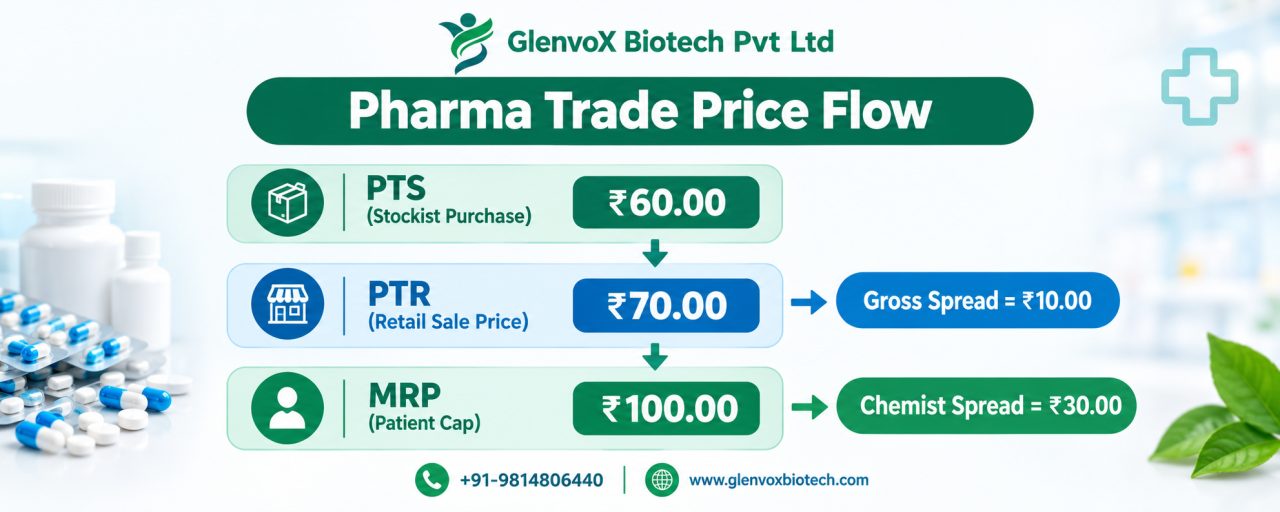
Breakdown of the Trade Flow:
- Stockist Procurement: The franchise partner acquires the item at a base PTS of ₹60.00.
- Chemist Distribution: The stockist supplies the retail chemist at a PTR of ₹70.00, creating a ₹10.00 gross spread per unit for the distributor.
- Consumer Sale: The chemist sells the product to the consumer at an MRP of ₹100.00, earning a ₹30.00 gross spread per unit.
How to Read a PCD Pharma Price List Step by Step
To analyze a new PCD Pharma Price List systematically, follow this 10-step evaluation method:
- Identify the Product: Verify the exact chemical composition, strength, and therapeutic category.
- Examine Pack Sizes: Check whether the quote is for a 10×10 blister, 10x1x10 ALU-ALU, a 60ml bottle, or a single vial. Comparing prices without matching pack sizes leads to incorrect calculations.
- Review the MRP: Note the retail ceiling printed on the catalog.
- Determine the PTS / Net Rate: Identify your primary procurement cost per unit.
- Analyze the PTR: Confirm the standard selling rate for retail chemists in your target market.
- Verify Tax Terms: Check whether quoted rates are Inclusive of GST or GST Extra (typically 12% or 18% depending on product category).
- Factor in Freight & Logistics: Determine if prices are F.O.R. (Free on Road) or if shipping charges will be billed separately.
- Check Promotional Schemes: Look for volume-based deals (e.g., 10+1 free) or seasonal cash discounts.
- Calculate Gross Spread: Subtract your total landing cost (PTS + Tax + Freight) from your net selling price (PTR minus any chemist schemes).
- Estimate Net Margin: Deduct operating expenses from your gross spread to evaluate true profitability.
How to Calculate Your Real Margin
Evaluating a PCD Pharma Price List requires using standard accounting formulas to measure product profitability.
1. Gross Margin Formula
Gross margin measures the raw monetary spread between selling price and purchase cost.
$$\text{Gross Margin (₹)} = \text{Selling Price} – \text{Purchase Cost}$$
To calculate Gross Margin as a percentage:
$$\text{Gross Margin \%} = \left( \frac{\text{Selling Price} – \text{Purchase Cost}}{\text{Selling Price}} \right) \times 100$$
2. Practical Calculation Example
Using our earlier hypothetical figures (Purchase Cost = ₹60.00, Selling Price/PTR = ₹70.00):
$$\text{Gross Margin (₹)} = 70 – 60 = ₹10.00$$
$$\text{Gross Margin \%} = \left( \frac{10}{70} \right) \times 100 = 14.28\%$$
Margin vs Markup: Don’t Confuse the Two
A frequent financial mistake when analyzing a PCD Pharma Price List is mixing up Margin and Markup. While both use the same rupee difference, they express profitability relative to different baseline numbers.
- Margin % is calculated relative to the Selling Price.
- Markup % is calculated relative to the Purchase Cost.
$$\text{Markup \%} = \left( \frac{\text{Selling Price} – \text{Purchase Cost}}{\text{Purchase Cost}} \right) \times 100$$
Comparing the Two (Using our ₹60 Cost / ₹70 Selling Price Example):
$$\text{Markup \%} = \left( \frac{70 – 60}{60} \right) \times 100 = \left( \frac{10}{60} \right) \times 100 = 16.67\%$$
$$\text{Margin \%} = \left( \frac{70 – 60}{70} \right) \times 100 = \left( \frac{10}{70} \right) \times 100 = 14.28\%$$
Key Takeaway: Markup percentage is always numerically higher than margin percentage. Mistaking a 16.67% markup for a 16.67% net margin will lead to overestimating business income.
Why MRP Is Not Your Actual Profit
A common misconception among new distributors reading a PCD Pharma Price List is assuming that a large gap between MRP and purchase cost translates directly into profit.
If a product has an MRP of ₹100.00 and a net PTS of ₹20.00, it might look like an ₹80.00 profit. However, in professional trade, you do not sell directly to patients at MRP. You sell to chemists at PTR, who then sell to patients. If the PTR is set at ₹35.00, your actual gross spread is ₹15.00 (₹35.00 PTR – ₹20.00 PTS), not ₹80.00.
Costs That Affect Your Real Business Profit
Your raw product margin is only the starting point. To determine actual net business profit from a PCD Pharma Price List, you must deduct overhead expenses:
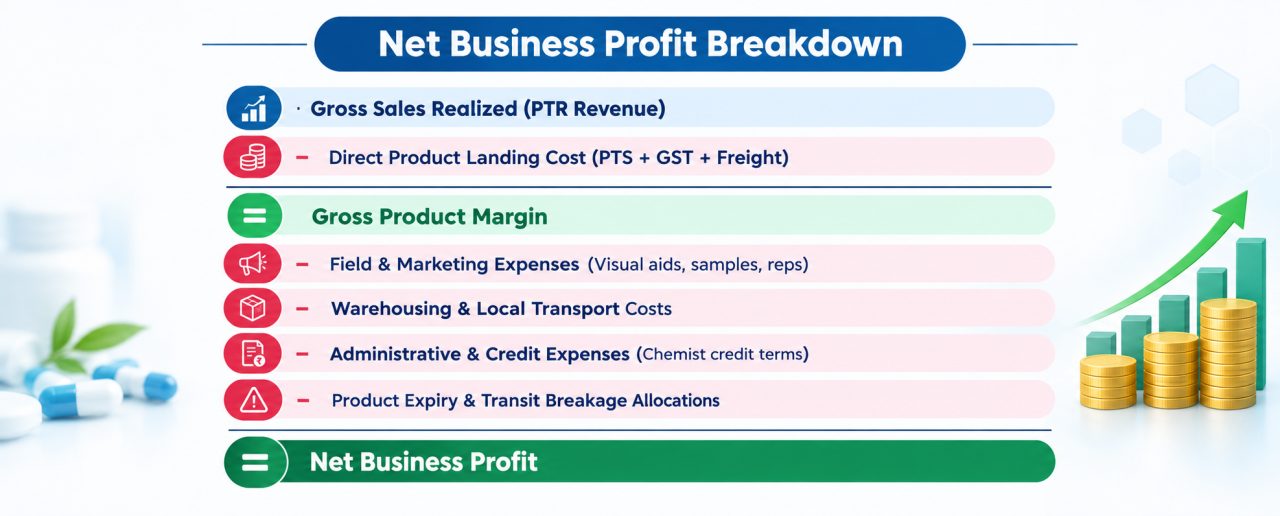
- Transportation & Freight: Shipping charges from the corporate facility to your local godown.
- Field Marketing Expenses: Distribution of visual aids, product glossaries, and physician samples.
- Sales & Administrative Overhead: Representative allowances, office utilities, and storage maintenance.
- Chemist Credit & Cash Discounts: Additional 2%–5% discounts offered to retail chemists for prompt payments.
- Breakage & Expiry Losses: Managing damaged goods or expired stock returned from retail outlets.
Common Mistakes When Reading a PCD Pharma Price List
Avoid these operational errors when evaluating a new PCD Pharma Price List:
- Ignoring GST Status: Assuming listed rates include GST when taxes are actually billed extra.
- Overlooking Pack Quantities: Comparing a 10×10 pack rate from one supplier with a 10x1x10 pack rate from another.
- Confusing Net Rates with PTR: Mistaking the retailer selling price for your stockist procurement price.
- Ignoring Shipping Costs: Forgetting to factor in freight charges, which reduces gross margin.
- Assuming Uniform Margins: Expecting high-margin returns across all therapeutic lines, when fast-moving generic lines often operate on tighter margins.
- Relying on Unwritten Schemes: Counting on promotional free goods that are not explicitly detailed in official commercial documentation.
What Else Should You Check Before Choosing a Pharma Company?
While analyzing a PCD Pharma Price List is crucial, numeric evaluation alone should not dictate your supplier selection. Commercial sustainability depends on product quality and reliable support.
When evaluating suppliers like Glenvox Biotech, review these complementary operational factors alongside the price list:
- Product Quality & Presentation: Secure ALU-ALU packaging, clear batch embossing, and high-grade raw materials.
- Formulation Portfolio: Availability of diverse dosage forms across key therapeutic segments.
- Regulatory Compliance: Access to valid WHO–GMP and ISO quality certifications.
- Supply Chain Reliability: Consistent stock availability and predictable dispatch timelines.
- Promotional Asset Support: Comprehensive detailing materials, visual aids, and sample support.
- Territory Protection: Clear, written monopoly rights to safeguard your market investments.
Evaluating companies like Glenvox Biotech across both price structure and operational reliability helps ensure a balanced franchise partnership.
How Glenvox Biotech Fits Into the Evaluation Process
When researching potential franchise partners, companies like Glenvox Biotech provide a practical benchmark for reviewing commercial transparency and product diversity.
Prospective business partners can evaluate Glenvox Biotech by requesting their current PCD Pharma Price List and reviewing key business metrics:
- Catalog Structure: Analyzing formulation options across tablets, capsules, oral liquids, and injectables.
- Commercial Clarity: Reviewing listed rates against standard industry PTR/PTS formulas.
- Support Capabilities: Assessing available promotional assets, visual aids, and delivery workflows.
Comparing various industry providers using structured criteria allows you to select a partner whose commercial model aligns with your business goals.
FAQs
Q1: What is the main difference between PTS and PTR on a PCD Pharma Price List?
PTS (Price to Stockist) is the net procurement rate at which the franchise partner or distributor purchases products from the pharmaceutical company. PTR (Price to Retailer) is the billing rate at which the distributor sells those products to retail chemists, pharmacies, or clinics. The difference between PTR and PTS represents the distributor’s raw gross spread.
Q2: Why shouldn’t I calculate my profit margin directly from the printed MRP?
In ethical pharmaceutical distribution, products are sold to retail chemists at PTR, not directly to end consumers at Maximum Retail Price (MRP). The margin between PTR and MRP is retained by the retail chemist. To calculate your own distribution margin, you must measure the spread between your purchase cost (PTS) and your selling price to retailers (PTR).
Q3: What is the difference between Margin % and Markup %?
Although both use the same rupee amount (Selling Price − Purchase Cost), they use different baseline numbers:
- Margin % measures profit relative to the Selling Price ($\text{Profit} \div \text{Selling Price} \times 100$).
- Markup % measures profit relative to the Purchase Cost ($\text{Profit} \div \text{Purchase Cost} \times 100$).Because Purchase Cost is lower than Selling Price, the Markup % will always be a higher number than the Margin %. Mixing them up leads to overestimating actual net income.
Q4: Are listed prices on a PCD Pharma Price List inclusive or exclusive of GST?
In most pharmaceutical wholesale catalogs, listed rates (PTS/DP) are exclusive of GST unless explicitly labeled as “Inclusive of Taxes.” Depending on the formulation and therapeutic category, GST (typically 12% or 18%) is added during billing. Always clarify tax terms before placing orders to ensure accurate landed-cost calculations.
Q5: What operating costs should be deducted from gross margin to find real net profit?
To determine your true net business profit, you must subtract operational overheads from your gross margin, including:
- Freight, shipping, and local warehousing expenses.
- Field promotional materials, physician samples, and visual aids.
- Administrative costs and sales representative allowances.
- Extra cash discounts offered to chemists for prompt payments.
- Potential losses from transit damage or expired returns.
Q6: What should I check regarding pack sizes when comparing price lists from different companies?
Always compare unit-level pricing rather than box-level pricing. A price list might quote a lower rate per box, but that box might contain a 10×10 strip format while a competitor offers a 10×1×10 ALU-ALU format or different unit counts. Verify the exact packaging layout, strip type (blister vs. ALU-ALU), and bottle volume before comparing costs across suppliers.
Q7: How does Glenvox Biotech structure commercial evaluation for prospective partners?
Companies like Glenvox Biotech provide clear price catalogs outlining MRP, trade rates, and formulation details across tablets, capsules, liquids, and topical lines. Prospective franchise partners evaluate Glenvox Biotech by requesting their current catalog to review product variety, regulatory documentation, promotional inputs, and transparent commercial terms against market standards.
Q8: Are promotional schemes and free goods automatically included in the price list?
Not always. While some companies build promotional schemes (such as 10+1 free or seasonal cash discounts) directly into their standard price lists, others offer schemes separately based on total order volumes or specific monthly offers. Always confirm active scheme terms in writing prior to placing stock orders.
Conclusion
Mastering how to read a PCD Pharma Price List is an essential business skill for any pharmaceutical distributor. By moving beyond printed MRPs and accurately calculating PTR, PTS, gross margins, and operating expenses, you can build a realistic financial plan.
Remember to evaluate every PCD Pharma Price List alongside core operational factors: product quality, supply reliability, and promotional support. Partnering with transparent, established firms like Glenvox Biotech ensures you build a sustainable distribution business based on clear commercial terms and mutual growth.
- #Best Franchise in India
- #Best PCD Franchise Business
- #Best PCD Franchise Business opportunity
- #Best pcd pharma franchise
- #Best PCD Pharma Franchise in India
- #Glenvox Biotech
- #How to Read a PCD Pharma Price List
- #MRP
- #pcd pharma franchise
- #PCD Pharma Price List
- #Pharma Franchise Margin
- #Pharma Franchise Price List
- #PTR and Your Real Margin
- #PTS
- #PTS vs PTR
- #Top pcd pharma franchise
Interested in a PCD pharma franchise?
Check monopoly availability for your area today.